
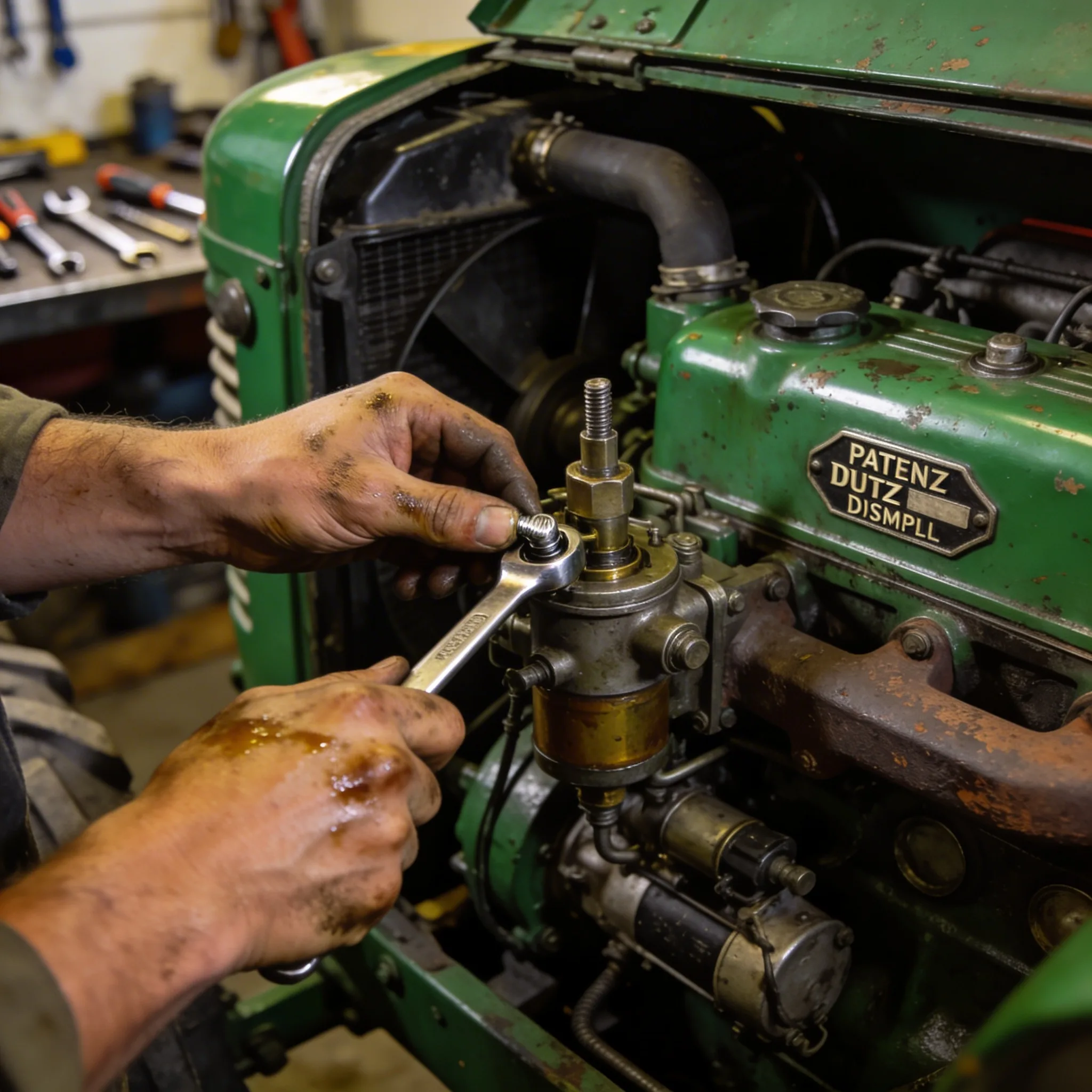
When Your Tractor Won’t Start: First Steps for Engine Problems
It’s the absolute classic: You turn the ignition key and instead of the familiar chugging, you hear only a tired “click” or the starter turns the engine over agonizingly slowly. Before you panic, let’s approach this systematically. When your tractor engine won’t start, it usually comes down to three things: power, fuel, or air.
Start with the battery. Is it fully charged? A multimeter will tell you the voltage, which should be above 12.4 volts. Are the terminals clean and tight? Corrosion can massively impede current flow. If the electrics check out, look at the fuel system. Is there enough diesel in the tank? Sounds obvious, but it’s a common fault source. Check the fuel filter – if it’s clogged, nothing reaches the engine. Another big topic is air in the system, especially after a filter change. Bleed the lines according to your workshop manual instructions. Finally, the glow system: Are the glow plugs working? Often just one is defective, and the cold start becomes a test of patience. With these first checks, you’ll solve the majority of starting problems.
Your Tractor Smokes Blue? Causes and Solutions
The color of the exhaust smoke is one of the best diagnostic tools we have. When your tractor smokes blue, the message is clear: Your engine is burning oil. It shouldn’t be doing that, of course, and the causes can be varied. The simplest and fortunately most harmless cause is too high an oil level. Did you perhaps overfill at the last oil change? Check the dipstick with the tractor level and the engine cold. If the level is above the maximum mark, drain some oil.
Often, however, the causes are more serious. Blue smoke, especially under load, frequently indicates worn piston rings or cylinder bores. The oil is no longer cleanly scraped from the cylinder wall and enters the combustion chamber. A compression test can provide clarity here. Another common cause is hardened or defective valve stem seals. Here, oil seeps along the valves into the combustion chamber, often noticeable as a blue cloud right after starting. While an oil change is quickly done, working on piston rings or valve stem seals requires considerably more mechanical experience.
When Is an Overhaul Due? Signs of Serious Engine Problems
Sometimes small repairs are no longer enough. When your faithful companion continues to suffer from serious engine problems despite all efforts, you may need to come to terms with a major operation. A clear indication that an engine overhaul is needed is a combination of several severe symptoms. These include persistent heavy blue smoke, massive power loss that even new filters can’t fix, and high oil consumption of more than a liter over just a few operating hours. Listen carefully: Loud, metallic knocking or hammering noises from inside the engine are an absolute alarm signal. Here, bearings or other central components are probably at the end of their service life. A compression test showing very low or widely varying values across all cylinders confirms the suspicion. An engine overhaul is no small matter, but often the only way to save the old diesel and give it a second life.
Systematic Diesel Engine Diagnosis: From Symptom to Cause
A successful repair always begins with good diagnostics. Instead of wildly swapping parts, you should proceed like a detective. The golden rule of diagnosis is: From symptom to system to component. The symptom is what you see, hear, or feel – for example, black smoke. The system responsible is in this case the mixture formation (air and fuel). The suspect components are then the air filter, the injectors, or the injection pump. Always work from the simplest to the most complex. A clogged air filter is quickly checked and cheaply replaced, while removing the injection pump is a whole different ball game. The right tools are essential for this work. A good workshop manual is your best friend. And of course, you need the right spare parts. Whether gaskets, filters, glow plugs, or stickers for the perfect look – you’ll find everything you need for your project with us.
Frequently Asked Questions About Tractor Engine Problems
What does it mean when my tractor produces black smoke?
Black smoke indicates incomplete combustion of diesel, meaning excess fuel or insufficient air. The most common causes are a clogged air filter, worn or incorrectly adjusted injectors, or a misadjusted injection pump. Check the air filter first – that’s the simplest and most likely solution.
My tractor suddenly loses power. What could be the cause?
Sudden power loss is usually due to a problem in the fuel system. A clogged fuel filter or air in the fuel line are the most common culprits. Check the filters and bleed the system per your workshop manual. Less commonly, a defect in the lift or injection pump can be the cause.
Is restoring an old tractor engine always worth it?
Whether an engine overhaul is worthwhile depends on the condition, the sentimental value of the tractor, and parts availability. If the engine’s substance is good and parts are easily sourced, it’s a very rewarding job that preserves a piece of engineering history for the future and increases the vintage tractor’s value.
Conclusion
As you can see, behind most engine problems there’s no magic – just solid engineering. With a systematic approach, some patience, and the courage to get your hands dirty, you can find many causes yourself. Don’t be discouraged by a stuttering engine! See it as a challenge and an opportunity to get to know your tractor even better. Because most tractor engine problems can be solved with the right knowledge and matching spare parts. What engine problem has driven you to despair?
Have you had experience with tractor engine problems? Find everything you need in our shop